

WFC Skew2
Action Space |
|
Observation Space |
|
Creation |
|
Description
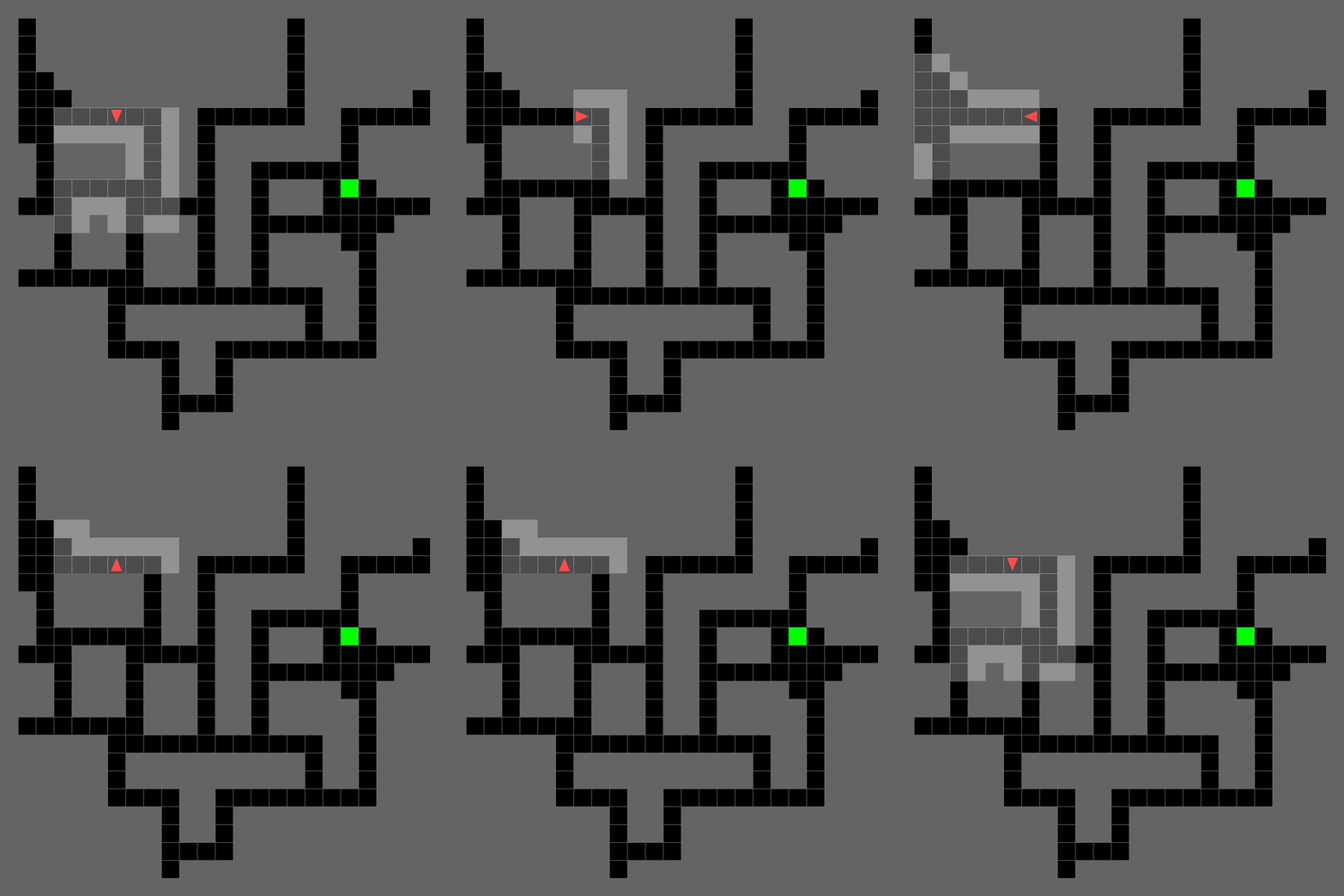
This environment procedurally generates a level using the Wave Function Collapse algorithm.
The Skew2 preset learns from a skewed pattern to create asymmetric cave-like layouts with angled wall contours.
See WFC module page for sample images of the available presets.
Requires the optional dependencies imageio and networkx to be installed with pip install minigrid[wfc].
WFC Preset
Preset |
|
Registered by default |
No |
Requires additional registration |
Yes |
Slow preset |
No |
Registration
This preset is not registered by default. Register the additional WFC preset group before creating it.
import gymnasium
from minigrid.envs.wfc.config import WFC_PRESETS_INCONSISTENT, register_wfc_presets

register_wfc_presets(WFC_PRESETS_INCONSISTENT, gymnasium.register)
Generation Notes
This preset is not marked as slow, but it can require many attempts to generate a consistent level.
Mission Space
“traverse the maze to get to the goal”
Action Space
Num |
Name |
Action |
|---|---|---|
0 |
left |
Turn left |
1 |
right |
Turn right |
2 |
forward |
Move forward |
3 |
pickup |
Unused |
4 |
drop |
Unused |
5 |
toggle |
Unused |
6 |
done |
Unused |
Observation Encoding
Each tile is encoded as a 3 dimensional tuple:
(OBJECT_IDX, COLOR_IDX, STATE)OBJECT_TO_IDXandCOLOR_TO_IDXmapping can be found in minigrid/core/constants.pySTATErefers to the door state with 0=open, 1=closed and 2=locked (unused)
Rewards
A reward of ‘1 - 0.9 * (step_count / max_steps)’ is given for success, and ‘0’ for failure.
Termination
The episode ends if any one of the following conditions is met:
The agent reaches the goal.
Timeout (see
max_steps).
Research
Adapted for Minigrid by the following work.
@inproceedings{garcin2024dred,
  title = {DRED: Zero-Shot Transfer in Reinforcement Learning via Data-Regularised Environment Design},
  author = {Garcin, Samuel and Doran, James and Guo, Shangmin and Lucas, Christopher G and Albrecht, Stefano V},
  booktitle = {Forty-first International Conference on Machine Learning},
  year = {2024},
}